a harmonious smile without artificial perfection

Your dentist
Dr Jacqueline Kovacevic, MSc
Time instead of conveyor belt.
Dentist for biomimetic and preventive dentistry. With KOVIVA, her aim is to rethink dentistry: with more time, precision and a clear focus on preserving natural teeth for the long term.
★★★★★ 5.0 · 67 Google reviews
Your
treatment
When veneers make sense and when they do not
REINFORCEMENT ONLY WHERE NEEDED
Veneers are thin ceramic shells bonded to the front of a tooth. They are the right choice when a front tooth already has a larger defect or a large filling, or is permanently discoloured after an accident.
They are not always the best solution. For younger patients we often prefer to work with composite. Modern composites can be shaped with great aesthetic finesse, and they have one decisive advantage: we can remove them in a controlled way and rebuild the tooth at any time. That is minimally invasive and keeps every option open.
A word on "no-prep" veneers. Veneers that are placed without grinding cannot simply be taken off again to return to the original situation either. The ceramic is firmly bonded to the tooth. If a veneer later has to be removed or replaced, for example because it is damaged, it is ground away. A treatment is gentle on the tooth not because little is removed at the start, but because it remains reversible.
Often it can be done without
LESS LOSS OF TOOTH SUBSTANCE THROUGH THE RIGHT ORDER
Many people want veneers or crowns because individual teeth are rotated. A crown requires a great deal of healthy tooth substance to be removed.
The same aesthetic result can often be achieved differently: first the teeth are moved into the right position with clear aligners, then a little composite or a single veneer is often enough. This preserves far more of the tooth and puts less strain on the nerve.
That is why aesthetic treatment with us often begins with the question of whether orthodontics should come first. We rarely place crowns any more anyway; in most cases an overlay is enough.
How the first consultation works
LISTEN, EXAMINE, DECIDE TOGETHER
We take our time, and first of all to listen. There are two perspectives: what you would like, and what the medical findings show. Both belong on the table.
Diagnostics include X-rays, usually a panoramic X-ray for an overview of the jaw structures and sinuses, supplemented by small detail images to check for decay. We also examine the oral mucosa. Dentists are often the first to notice changes there. In addition, we go through your medical history carefully.
For straightforward questions we discuss the approach straight away. For more complex situations we arrange a second appointment, usually in the same or the following week. By then we prepare a treatment plan and a written cost plan.
This plan is not a formality. If several things need doing, it sets the order by urgency, and you know in advance what to expect.
Something to consider first: whitening
WHY THE ORDER MATTERS HERE
Before we start planning, we discuss whether you would like teeth whitening first. The reason is practical: veneers are made in a fixed shade, while your other teeth keep their natural colour.
If you want lighter teeth overall, whitening should therefore take place before the veneers are planned. That way we can match the shade of the veneers to it. The colour of veneers cannot be changed afterwards.
Every whitening is preceded by a check-up. The teeth must be healthy and the mouth free of inflammation. That is why we advise against whitening products from the chemist or supermarket: without a prior examination it is unknown whether treatment is even advisable, and undetected decay or inflamed gums can get worse as a result.
How veneer treatment works with us
FROM PLANNING TO FITTING
Planning appointment. We take photos and make a digital scan of your teeth. This appointment is thorough, because it lays the foundation for everything that follows.
The planning you do not see. Then the part away from the treatment chair begins. We plan your veneers digitally and coordinate closely with our dental technicians, specialised laboratories in Salzburg and Tyrol with whom we work fully digitally. This preparation largely determines the result.
Discussion and mock-up. One to two weeks later we look at the plan together. If the shape of your teeth changes noticeably, we make a mock-up: a preview in temporary material that we try directly in your mouth. This lets you see the planned result before anything is changed on the tooth.
Only once you agree do we continue.
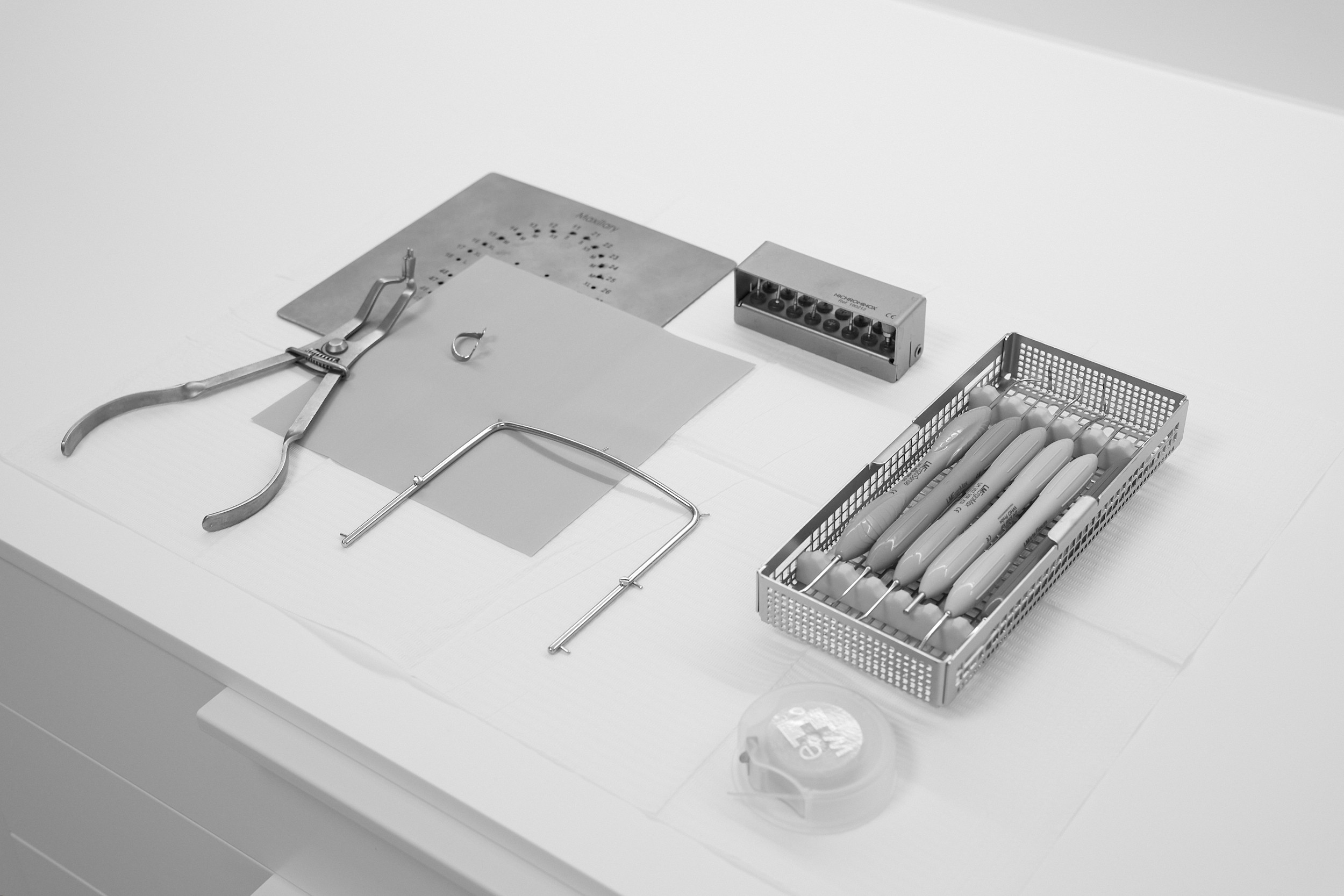
Preparation. A longer appointment under local anaesthetic. We work with a rubber dam, a complete isolation of the working area, which is decisive for the durability of adhesive bonding. The tooth is sealed so that no bacteria can get in and it does not react sensitively after the appointment. We then take a scan for the laboratory, and you leave the practice with temporaries in the planned new shape.
Try-in and fitting. Around two weeks later the finished veneers arrive from the laboratory. We try them in, and if everything fits, they are bonded in the same appointment.
Follow-up checks. After fitting there are one to two check-up appointments. A few weeks to months later we ask you to come back once more, because the gums reshape themselves during this time. We take photos at every appointment and look at the progress together.
Timeframe: from the first consultation to the finished veneers usually takes four to six weeks.
Durability: why we talk about it differently
WHAT HAPPENS WHEN THE RESTORATION AGES
With good care and regular check-ups, high-quality composite fillings and ceramic or resin overlays can last for many years. How long depends, among other things, on the size of the restoration, teeth grinding and oral hygiene.
But something else matters more to us. No dental material lasts forever; every restoration ages. What counts is what happens then.
If after many years only the restoration needs renewing and the tooth beneath it has stayed healthy, the treatment was a success. We take out the old restoration and make a new one. The tooth stays.
It becomes a problem when more tooth substance is lost with every renewal. A filling becomes a larger filling, then a crown, and in the end the tooth is lost. That is exactly the chain we want to avoid. This is what we mean when we speak of preserving teeth instead of replacing them.
Briefly answered
Frequently asked questions.
What are veneers and when do they make sense?
Veneers are thin ceramic shells bonded to the front of a tooth. They can make sense when a front tooth already has a larger defect or a large filling, or is permanently discoloured, for example after an accident. They are not always the best solution: for younger patients we often prefer to work with composite.
What are no-prep veneers?
No-prep veneers are bonded to a tooth that is largely unprepared. This can work if there is enough room for the additional ceramic. However, these veneers cannot simply be taken off again to return to the original situation either. The ceramic is firmly bonded to the tooth. If a veneer later has to be removed or replaced, for example because it is damaged, it is ground away.
Can crooked teeth be corrected without veneers?
Often, yes. The desired result can often be achieved differently: first the teeth are moved into the right position with clear aligners, then a little composite or a single veneer is often enough. This is considerably more tooth-preserving and puts less strain on the nerve.
How long does it take to get veneers?
From the first consultation to the finished veneers usually takes four to six weeks. In between come a planning appointment, a discussion of the plan (with a mock-up if the shape changes noticeably), preparation under local anaesthetic, and try-in and fitting.
Should I whiten my teeth before getting veneers?
If you want lighter teeth overall, yes. Veneers are made in a fixed shade and their colour cannot be changed afterwards, so whitening should take place before the veneers are planned.
How long do veneers last?
With good care and regular check-ups, ceramic veneers can last for many years. There is no fixed number that applies to every tooth. How long an individual veneer lasts depends on factors such as the preparation, bonding technique, bite and daily load; the risk is higher, for example, with heavy teeth grinding.
Costs and reimbursement
What you should know
about billing.
KOVIVA is a private practice (Wahlarztpraxis). We bill you directly and you receive an invoice listing all treatments provided.
For eligible treatments, your Austrian health insurance reimburses part of the costs. We submit the invoice for you.
We answer questions about costs personally, by phone or WhatsApp on +43 670 508 24 44 or by email to hello@koviva.at. For the initial consultation and professional cleaning we can tell you the fee straight away; for all other treatments after the examination, because it depends on the scope of treatment. More on costs and reimbursement